This guide walks you through exactly how to start indoor cycling safely and confidently, even if you have never clipped in before. You will learn how to set up your bike, ride with good technique and track progress without getting overwhelmed.
TL;DR
To start riding indoors, all you really need is a compatible indoor trainer, your bike, a bit of space and an indoor cycling app like ROUVY to make it more fun and real.
The app is part of your setup. It controls resistance automatically and turns a static trainer into immersive rides on real-world routes, which makes consistency far easier. You don't need top-end gear to begin, but do take a few minutes to set up your bike properly, since comfort is what makes you want to come back, and poor setup causes most early aches and injuries.
Keep your first sessions short and simple: a gentle warm-up, some easy riding with a few harder efforts mixed in, and a relaxed cool-down. Ride a few times a week, and resist the urge to go hard every time. Easy rides and rest days are where fitness actually builds. Aim for a smooth, comfortable cadence and focus on consistency over numbers.
The biggest thing is just showing up. Most beginners notice real changes within a few weeks (stronger legs, easier breathing, better mood), and the trick is making riding easy to start. Leave your bike set up, keep your gear nearby and use engaging routes or guided workouts to stay motivated once the novelty wears off.
Why indoor cycling is perfect for beginners
Indoor cycling removes many of the barriers that stop one from exercising consistently.
You do not need traffic awareness. You do not need perfect weather. You do not need advanced skills. You just need a compatible trainer and your bike, a bit of space, and the willingness to start gently.
For many athletes, especially beginners, indoor cycling offers three big advantages.
First, it feels safe and predictable. Resistance is controlled automatically in SIM (on routes) and ERG mode (in workouts). Cadence is measurable (higher revs are better). No hills are sneaking up on you unless you choose them.
Second, it is low impact. Your joints stay supported, which makes it ideal if you are returning to exercise, carrying extra weight, or easing back after time off.
Third, it fits real life. A 30 minute ride before work or after dinner is suddenly realistic. No packing. No commuting. Just ride and enjoy.
For results to count, consistency matters a lot and indoors makes consistency easier. So let’s take a look at how this can be made easier.
Above: Choosing a route from the vast route library is easy using the filters.
How to prepare: Gear, setup and safety basics
You do not need expensive equipment to start, but you do need a setup that feels comfortable, is compatible and also stable.
A towel to prevent a swimming pool from forming below you.
A fan or two will make the ride easier and more pleasant.
Optional but helpful:
Cycling shoes with cleats, as you’ll need to pull up on the climbs, not just stomp downwards.
A heart rate monitor or smartwatch.
Before your first ride, take five minutes to set your bike up properly. Poor setup causes most beginner discomfort and nearly all early injuries.
We cover this in detail in our step-by-stepindoor cycling setup guide. Going for a professional bike fit can also prevent injuries caused by incorrect initial set-up from the start.
Quick setup cues to remember
Seat height: When the pedal is at the bottom, your knee should be slightly bent.
Seat fore and aft: Kneecap roughly above the ball of your foot.
Handlebars: High enough that your back feels relaxed, not folded.
If something hurts sharply or feels unstable, stop and adjust. Discomfort fades, but any ongoing pain should not be ignored. A proper bike fit is then highly recommended.
Proper indoor cycling posture and technique
Good technique makes riding feel smoother and more efficient. It also protects your knees, back, and shoulders.
Upper body position
Your hands rest lightly on the bars. Not clenched or locked. Engage your core muscles for stability.
Elbows should be relaxed.
Shoulders should be down and relaxed.
Keep the chest open to breathe easier.
Look forward, not down.
You should feel strong and steady, not tense.
Lower body movement
Pedalling should feel circular, not choppy.
Push down through the ball of your foot.
Pull lightly through the bottom of the stroke.
Keep knees tracking straight, not pointing outward.
A good cadence for beginners sits between 80 and 90 RPM (Revolutions Per Minute) most of the time. Slower gives more resistance. Faster spins with less load. You will find your rhythm quickly. A higher cadence takes practice, so the sooner you get into the habit, the sooner your legs will adapt.
Starting to use the app can feel strange at first. The bike or trainer isn’t moving, yet your legs suddenly perform movements they haven’t done in a while, or perhaps never, as your avatar rolls off the start line. You see metrics and riders overlaid on beautiful scenery, and then the immersion and addiction kick in.
Once you settle in, indoor cycling is one of the most accessible ways to build fitness. It offers controlled training that is surprisingly addictive. It becomes habit-forming, too, before you know it!
You don’t need complicated plans to get results, just a beginner cycling training plan and a structure that makes sense.
A simple beginner ride template
Warm up
5 to 10 minutes.
Choose a route and ride it in Zones 1 and 2, gradually increasing cadence.
You’ll know which zones these are, as you should be able to speak in full sentences.
Main set
Pedal for 15 to 25 minutes
Short efforts with recovery Example:
2 minutes steady
1 minute slightly harder
Repeat 5 to 8 times
Cool down
5 minutes
Light spinning to bring heart rate down.
That’s it. Keeping it simple works.
If you want guided sessions, virtual rides, or structured plans, ROUVY makes it easier to stay focused without overthinking. Beginner friendly routes, like the Italian or Swiss lake and starter workouts help you learn pacing naturally while staying engaged.
In this video, we count down the TOP 10 easiest and most beautiful routes on ROUVY.
Indoor cycling benefits for beginners
Personal improvements often show up faster than expected. Within the first few weeks, most beginners start noticing changes in how they feel day to day, not just how they look. Riding becomes smoother, effort feels more manageable, and confidence on the bike grows.
Cardiovascular fitness
Indoor cycling strengthens your heart and lungs in a very practical way. Breathing starts to settle more quickly during effort, recovery feels easier, and everyday tasks like walking up stairs get easier. Many beginners also notice a general lift in daily energy, especially once riding becomes part of a regular routine.
Strength and muscle endurance
Indoor cycling builds functional, useful strength, not bulk. The muscles you rely on most during daily movement gradually become stronger and more resilient. This includes the quadriceps, glutes, hamstrings, and the core stabilisers that help keep your posture steady on and off the bike. Over time, this strength translates into better control, smoother pedalling, and less fatigue during longer rides.
Calorie burn and weight management
Cycling burns a meaningful number of calories while remaining gentle on your joints, which makes it easier to ride consistently. When combined with regular effort and sensible nutrition, indoor cycling supports sustainable weight loss without placing unnecessary strain on your body. That balance is one reason many beginners find it easier to stick with it over the long term.
Mental benefits
This part often comes as a surprise. Riding indoors creates structure, a sense of routine, and a clear marker of progress. Showing up, even for a short ride, can reduce stress and provide a noticeable mood lift and stress relief. Over time, that feeling of steady forward movement becomes just as motivating as the physical results.
Tracking progress without getting obsessed
You do not need every metric on day one. In fact, too much data early on often creates more confusion than motivation. A few simple numbers are enough to help you understand your effort and stay engaged as fitness develops.
Cadence
Cadence, measured in RPM, shows how fast you are pedalling. You’ll feel comfortable between 80 and 90 RPM during steady efforts, where the movement feels smooth and controlled rather than forced. As fitness improves, holding a steady cadence usually becomes easier and more natural.
Heart rate
On easy rides, you should be able to hold a conversation without feeling short of breath. Moderate efforts challenge your breathing but still feel sustainable for several minutes. Hard efforts feel focused and brief, with recovery needed soon after.
If every ride leaves you exhausted, it is usually a sign that intensity is too high. Progress comes from mixing easy and harder sessions, not from pushing at the limit each time.
In this article, you can read about some interesting myths about heart rate training.
Power
Power reflects how much work you produce at a given moment, measured in watts. For beginners, it works best as a trend over time, not a target to chase each ride. Early improvements often show up as higher average power at the same perceived effort, rather than sudden jumps in peak numbers.
Day to day variation is normal. Fatigue, sleep, hydration, and stress all influence power output. A flatter ride does not mean lost fitness. Over several weeks of consistent riding, average power typically increases as efficiency and muscular endurance improve.
Common beginner mistakes and how to avoid them
Most beginner mistakes come from good intentions. You feel really motivated, your progress feels exciting, and suddenly every ride turns into a hard one. The trick is learning when to ease off.
Going too hard too often
It’s tempting to push every session, but more effort does not always lead to more progress. Easy rides build aerobic fitness, improve recovery, and make harder sessions more effective. If every ride feels hard, your body never gets the chance to adapt.
Ignoring bike fit
Small discomforts are easy to ignore at first. A sore knee. Tight shoulders. Numb hands. Left unchecked, those little issues often grow into injury. Take time to adjust your saddle height, reach, and handlebar position early on. Comfort makes consistency possible.
Comparing yourself to others
Indoor cycling makes comparison easy. Power numbers and leaderboards can distract from your own goals. Everyone starts at a different place, with various fitness goals. Your progress only needs to make sense for you. Focus on how your own riding feels from week to week and what it’s doing for you.
Skipping recovery
Rest days can feel unproductive, especially when motivation is high. In reality, recovery is where fitness actually happens. During recovery, muscles repair, energy systems adapt, and fatigue is cleared. Skipping rest often leads to plateaus or overtraining. Taking a day off is part of your progress and improvement.
Do I want a standalone smart bike or to use my own bike indoors?
Do I value quiet riding?
Do I prefer to program my own gears (on a smartbike) or use the mechanical gears I have on my bike?
You do not need top end gear to start. You need something stable, adjustable, and reliable.
"When I first started indoor cycling many years ago, I rode on a basic wheel on a trainer. Over time, I moved to a direct drive trainer and eventually to a smart bike. Each step simply followed my needs, not a rush for better gear." - Lauren Wolff
These days, smart trainers have come down in price, and a Wahoo Kickr Core 2 (a very popular choice for first timers), for example, costs around €500.00. A smart trainer gives you the full benefit of SIM and ERG modes on the app.
Above: This is what a direct drive smart trainer looks like using your own bike.
Get the right trainer for your first indoor setup
Every trainer and smart bike below works with ROUVY. Pick a setup that fits your budget, your space, and how you like to ride.
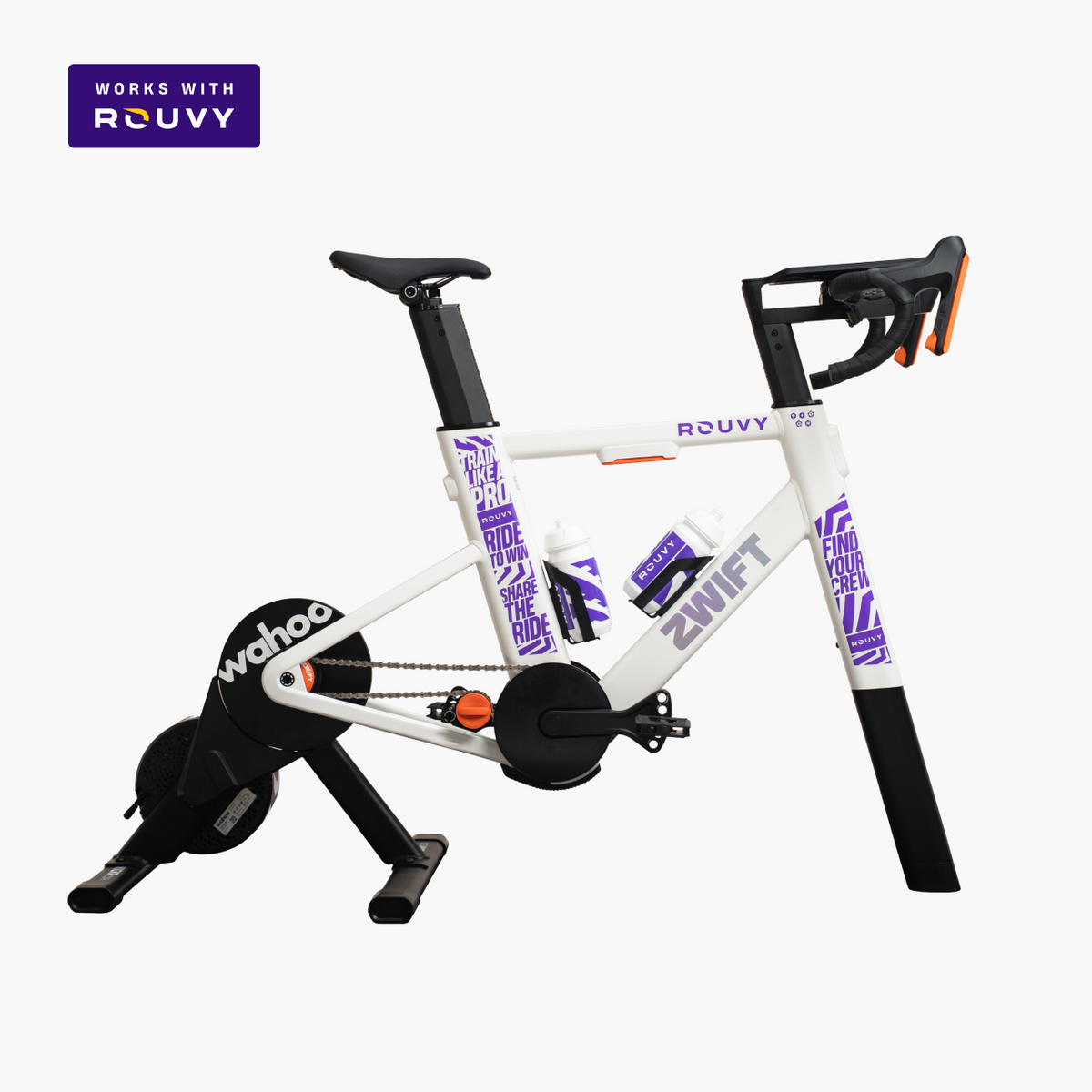
An always-ready indoor bike setup with the Zwift Ride Smart Frame and KICKR CORE 2 trainer included. The ROUVY Edition comes with a Personalized Sticker Set at no extra cost, so you can customize the look of your Zwift Ride and make it your own. Open ROUVY and ride without mounting your outdoor bike every time.
Why you’ll like it
Gives you a dedicated indoor setup that is ready whenever you want to ride.
Follows real ROUVY gradients through the KICKR CORE 2 smart trainer.
Lets you shift virtually with quiet, customizable virtual gear shifting.
The new Zwift Ride features multiple crank lengths, more saddle adjustability, and redesigned larger-diameter handlebars for an easier, more comfortable fit.
Makes setup and adjustments simple with a single tool that stores directly on the frame.
Includes the Personalized Sticker Set at no extra cost, so you can customize the look of your Zwift Ride.
Helps keep sweat, wear, and repeated trainer setup away from your outdoor bike.
ROUVY compatibility
Works with ROUVY as a complete indoor setup with Zwift Ride with KICKR CORE 2, supporting real-route resistance, power data, and virtual shifting.
Best for
Riders who want a permanent, shared, or always-ready indoor cycling setup, with an easy-to-adjust fit and a personalized ROUVY look, without using their outdoor bike.
A direct-drive smart trainer with Zwift Cog & Click preinstalled, built for a quieter and simpler ROUVY setup without cassette hassle. Ride real-world routes, feel every gradient, and shift virtually Why you’ll like it Follows ROUVY’s real route gradients, so climbs get harder and descents ease off naturally. Lets you shift virtually from the handlebars to find the right cadence on every route. Works with most 8 to 13-speed bikes, making bike swaps much easier. Direct-drive design gives you a stable ride feel with no tire wear or wheel slip. Built-in WiFi helps with smoother pairing, updates, and day-to-day setup. ROUVY compatibility Works with ROUVY for smart resistance, real-route gradients, power data, and virtual shifting with the included Zwift Cog & Click, giving you a quieter setup for riding real routes indoors. Best for Riders who want a reliable direct-drive trainer with virtual shifting, quiet operation, and a simpler indoor cycling setup. Specifications Trainer Type Direct drive smart trainer Resistance System Electromagnetic Drivetrain Belt drive, smooth and virtually silent Maximum Power Output 1800W Maximum Simulated Gradient 16% Power Accuracy ±2% Flywheel 5.4 kg Connectivity Bluetooth, ANT+, Wi-Fi, with multi-color LED status indicator and automatic firmware updates KICKR Bridge Streams heart rate monitor data to Zwift Cassette Compatibility Zwift Cog V2 pre-installed, compatible with almost any 8–13 speed bikes Axle Compatibility Thru-axle 12x142 and 12x148 adapters included, standard quick-release 130/135mm steel skewer included Accessory Compatibility KICKR CLIMB and KICKR HEADWIND smart fan Frame Steel, for a stable, sure-footed ride Max Rider Weight 114 kg Product Dimensions 59.7 cm L × 52 cm W × 47 cm H Box Dimensions 66 cm L × 23 cm W × 46 cm H Unit Weight 19.7 kg
A compact direct-drive smart trainer with Zwift Cog & Click preinstalled, made for real-route riding with less setup friction. Ride ROUVY climbs, workouts, and endurance routes with smart resistance and virtual shifting. Why you’ll like it Follows ROUVY route gradients, so climbs and descents feel connected to the road. Includes Zwift Cog & Click for a cleaner virtual shifting setup. Handles steep indoor climbs with enough resistance for demanding routes. Compact shape, foldable legs, and integrated handle make it easier to store. Quiet direct-drive riding helps your setup feel smoother and less disruptive. Works with most 8 to 13-speed bikes, making bike swaps much easier. ROUVY compatibility Works with ROUVY for smart resistance, real-route gradients, power data, and virtual shifting with preinstalled Zwift Cog & Click, giving you a compact setup for riding real routes indoors. Best for Riders who want a compact smart trainer with virtual shifting, real climb feel, and easy storage. Specifications Home Trainer Type Smart direct-drive home trainer Sprocket / Cassette Zwift Cog & Click included Power Meter Accuracy ±2.5% Max Slope Simulated 18% Max Power 920W (20km/h) – 2000W (40km/h) Wireless Communication Bluetooth® (Zwift Protocol, FTMS after firmware update, Power, Speed & Cadence), Wi-Fi (2.4GHz Direct Connect Protocol) Automatic Calibration No Firmware Updates Yes, automatic over Wi-Fi Rizer Compatible Yes Square Compatible Yes Output Power, speed, cadence Pedal Analysis No Flywheel 3.5 kg / 7.7 lbs Front Wheel Support Not included Bike Compatibility Road, gravel, mountain, and city bikes Freehubs Available Shimano Micro Spline, Campagnolo, SRAM XD/XDR Included Adapters Quick release Ø5x130-135, Thru-axle Ø12x142 Adapters Available Thru-axle Ø10x135-12x135, Specialized SCS Ø12x135, Boost Ø12x148, Super Boost Ø12x157 Open Size (L x W x H) 523.5 x 698 x 493 mm / 20.61" x 27.48" x 19.40" Closed Size (L x W x H) 523.5 x 164 x 493 mm / 20.61" x 6.46" x 19.40" Weight 10 kg / 22.05 lbs Max Load 110 kg / 242.50 lbs Power Supply Input 100-240V 50-60Hz, Output 12V 1.5A
A value-focused direct-drive smart trainer with Zwift Cog & Click V2 included. Built for quiet indoor riding, smart resistance, and real-route training in ROUVY. Why you’ll like it Lets ROUVY control resistance from real GPS route gradients. Gives you enough resistance for everyday climbs, intervals, and fitness rides. Direct-drive setup means no tire wear, no wheel slip, and a steadier ride feel. Cog and Click are included for a quieter, simpler virtual shifting setup. Multiple connection options help you pair with different devices and training spaces. Works with most 8 to 13-speed bikes, making bike swaps much easier ROUVY compatibility Works with ROUVY for real-route resistance, power data, and virtual shifting with the preinstalled Zwift Cog & Click, giving you a cleaner setup for riding real routes indoors. Best for Riders who want a capable direct-drive trainer at strong value for a smoother indoor cycling setup. Specifications Trainer Type Direct drive smart trainer Resistance System JetBlack Proprietary Electromagnetic System Maximum Power Output 1800W Maximum Simulated Gradient 16% Power Accuracy ±2% Flywheel 4.7 kg Connectivity Bluetooth FTMS, ANT+ FE-C, Zwift Protocol, Wi-Fi, USB-C Cassette Compatibility Zwift Cog pre-installed, compatible with almost any 8–12 speed bike out of the box Auto Calibration Automatic spin-down calibration, maintains power accuracy throughout the ride Odometer Tracked via the JetBlack App Axle Compatibility Quick Release 130/135mm, Thru Axle 142/148mm (adaptors included) Max Rider Weight 120 kg / 264 lbs Operating Temperature -10°C to +35°C / 14°F to 95°F Unit Weight 16.9 kg Power Supply Input 100-240V 50-60Hz, 1.5A Handle Integrated carry handle
Motivation fades. Habits last. Indoor cycling sticks when it fits your life, not when it relies on willpower.
Keep rides short and realistic, especially at the start. Choose times that feel manageable, not ideal. Mix easier rides with slightly harder ones to stay engaged, and use variety to prevent boredom.
Some weeks will feel better than others. That’s normal. What matters most is showing up often enough for riding to become routine rather than a decision.
Make riding easy to start
Leave your bike set up always.
Keep shoes, a towel and water nearby.
Choose short sessions on busy days.
Ride with purpose
Virtual rides, challenges, and structured workouts keep boredom away. Many riders stay consistent because riding feels like an experience, not a chore.
Some riders joke that the indoor season “starts when motivation ends”. You know that moment when the rain comes down, and with only a short time to spare for training, you’re trying to convince yourself that a quick trainer session is worth it.
Most beginners start noticing changes after two to four weeks. Legs feel stronger, breathing settles faster, sleep often improves, and confidence on the bike grows. These early shifts matter more than visible results.
Progress comes from showing up regularly, even on average days. Ride often enough and the improvements follow, quietly but reliably.
Final thoughts
Starting indoor cycling does not require you to train like a top athlete. It asks for a bit of patience and the willingness to keep learning as you go.
Some rides will feel smooth-going and satisfying. Others will feel harder for no obvious reason. Both still count, and both move you forward in their own way.
When you focus on comfort, consistency, and finding your own rhythm, indoor cycling slowly becomes part of your routine. Something that supports your day.
And once riding feels normal, progress tends to follow without much forcing.
Ready to start riding?
Set up your bike, choose a short beginner ride, and just start pedalling.
Try your first indoor ride with ROUVY and see how structured routes and realistic pacing make getting started feel easier than expected. You do not need to go hard. You just need to begin.
Frequently asked questions about indoor cycling for beginners
Lauren Wolff
ROUVY Writer
With a background spanning 30 years in the creative and writing industries, Lauren brings her love of storytelling and cycling together in her work for ROUVY. A lifelong athlete with almost 40 years of racing experience, she spent a couple of years riding with a semi-professional road racing team and went on to achieve podiums at National Championships and UCI World Masters events. She also completed the gruelling 2005 Cape Epic and earned triathlon medals back in the early ’90s. Lauren has trained on ROUVY year-round since 2016 and writes passionately to inspire others to ride and explore.
The bike is useful for runners when it has a job. It can add aerobic work without another set of foot strikes, keep a disrupted week moving, or rest your legs from the pavement. It shouldn't become a second programme piled on top of a full running week.
The Life Time Grand Prix unites the top gravel and mountain bike racers in one elite U.S. series across six challenging events. In 2025, the competition offers a $380,000 prize purse and a mix of legendary routes - now also available to experience virtually on ROUVY.
Wondering what TSS in cycling really means? This guide breaks down Training Stress Score (TSS) in simple, practical terms – no confusing math required. Learn how to use TSS to balance effort and recovery, manage your training load, track progress with precision on ROUVY and more.
Most cyclists focus on power and equipment, but overlook breathing. Learning to breathe more efficiently can make hard efforts feel smoother, improve pacing, and help you hold power longer – with simple techniques you can practise on any ride, indoors or out.
Stronger legs help cyclists produce more power, resist fatigue, and stay injury-free. One or two simple strength sessions per week - focused on squats, hinges, and single-leg work—can significantly improve your riding performance.
Plyometric leg exercises turn strength into explosive power by training you to absorb force and spring back quickly. With controlled jumps and landings, you build reactive strength, better stability, and faster acceleration that carries over to sport and cycling.
Cholesterol plays a powerful role in your long-term health. Even strong, dedicated riders can have levels that need attention. Here’s how smart, consistent cycling could help support a healthier heart from the inside out.
Artificial intelligence is revolutionizing the way cyclists train. With an AI cycling coach, riders can access personalized insights, adaptive training plans and real-time feedback. Whether you’re preparing for a race or just working to improve your fitness, discover how AI training for cyclists is transforming both outdoor and indoor performance.
Starting indoor cycling is easier with the right terrain. Discover 10 beginner routes on ROUVY featuring flat profiles, gentle gradients, and scenic real-world roads - ideal for steady aerobic rides, easy days, and building endurance from the ground up.
:quality(65)/%2Fcms%2FIndoor_cycling_for_beginners_4869aec7df%2FIndoor_cycling_for_beginners_4869aec7df.png)
:quality(65)/%2Fcms%2FChoosing_a_route_cc0762c3c3%2FChoosing_a_route_cc0762c3c3.jpg)
:quality(65)/%2Fcms%2Findoor_cycling_setup_71fa0675ba%2Findoor_cycling_setup_71fa0675ba.jpg)
:quality(65)/%2Fcms%2Frouvy_indoor_cycling_setup_cb3c0990e6%2Frouvy_indoor_cycling_setup_cb3c0990e6.png)
:quality(65)/%2Fcms%2Fhappy_girl_46a603323a%2Fhappy_girl_46a603323a.png)
:quality(65)/%2Fcms%2Fkickr_wahoo_trainer_0616638726%2Fkickr_wahoo_trainer_0616638726.png)


:quality(65)/%2Fcms%2Fworkouts_runners_cover_image_67e1227b03%2Fworkouts_runners_cover_image_67e1227b03.jpeg)
:quality(65)/%2Fcms%2FLTGP_c512b15b99%2FLTGP_c512b15b99.jpg)
:quality(65)/%2Fcms%2Ftraining_stress_core_cover_photo_f0406dc136%2Ftraining_stress_core_cover_photo_f0406dc136.jpg)
:quality(65)/%2Fcms%2Fbreath_cfc86f482b%2Fbreath_cfc86f482b.jpg)
:quality(65)/%2Fcms%2Fleg_workouts_2abcac2edd%2Fleg_workouts_2abcac2edd.jpg)
:quality(65)/%2Fcms%2FLeg_Exercises_e85e3fba1a%2FLeg_Exercises_e85e3fba1a.jpg)
:quality(65)/%2Fcms%2FCholesterol_7533bf15f4%2FCholesterol_7533bf15f4.png)
:quality(65)/%2Fcms%2Fai_for_cyclists_cover_photo_99e74410c5%2Fai_for_cyclists_cover_photo_99e74410c5.jpg)
:quality(65)/%2Fcms%2Frouvy_indoor_cycling_app_b98d9c967a%2Frouvy_indoor_cycling_app_b98d9c967a.jpg)